Showing posts with label professional development. Show all posts

Thursday, July 9, 2009

Because Writing Matters--Review and Discussion Questions

To be honest, I got roped into reading this one. There was a kerfluffle having to do with two different workshops my writing project site was hosting this summer. One was an online book discussion group and one was based on the NWP publication Because Writing Matters. In the turn of events the book discussion group wound up reading this also.


I started the book with a great deal of reluctance. I expected it to be dry and dense. It was neither. The NWP and Carl Nagin did an excellent job of making the case for why there should be writing at all grade levels and in across the curriculum. He used case studies of real teachers and schools that used writing to improve their students academic achievement. Often these improvements were was about as subtle as news coverage of Michael Jackson’s funeral.

To help make the case to administrators and central office personnel, he focused some chapters on what they, by virtue of their jobs and the current political climate, must focus on: test scores. He also made sure that all the facts in the book were products of and backed up by research--not just the anecdotal evidence of a few classrooms. This is also mandatory today, as it should be. If teachers don’t use research to inform their instruction, they are doomed to Santayana’s vicious circle.

In reading the book I was reminded of practices that I need to promote more in my classroom and was constantly stopping the reading to either make notes about changes to my classroom site (or just going ahead and making the changes I wanted to see in my online world).

While the information here is nothing that an NWP member would not expect, it is still an excellent summation of the current research as well as a powerful argument for the need to make the teaching of writing all-pervasive in our schools, at all levels.

It would make excellent reading for staff development, especially via the format of professional reading groups. And, with that in mind, I would like to offer some of the pre-reading, reading, and post-reading questions that we developed in my book study group.


PREREADING QUESTIONS

1. Describe your view of the teacher's role in the teaching of writing.

2. Describe your view of the student's role in the teaching of writing.

3. Describe your view of the administrator’s role in the teaching of writing.

4. How would you rate the importance of writing in education in general, and your subject in particular?

(These would also make excellent post-reading questions. The participants could compare their original answers with those they hold after reading the book.)


QUESTIONS AFTER READING THE INTRODUCTION

1. Should there be a required course for all teachers on writing pedagogy?

2. How could it be "sold" to the students as being important in their particular discipline?

3. Should there be a stronger composition requirement for Language Arts majors? It seems that the stereotype of an English teacher has been someone who loves the literature so much they want to re-experience it and share it with others. Would a stronger writing component, maybe requiring courses in writing from the English department as well as literature, help?

4. What book on writing pedagogy has most influenced your instruction of writing in the classroom? I would be interested in more than the title and author, but also in the hows and whys of this book's importance to you. For the purposes of the question limit yourself to one (or at most two) books.

QUESTIONS AFTER READING CHAPTER ONE

1. If writing is a subject that can never truly be completely mastered, what should our goals as writing instructors be?

2. How do you deal with the ambiguity in writing instruction--the idea that there is no guaranteed formula for success every paper? How do you get students to deal with it without becoming so frustrated they quit writing?

3. How can we teach, maybe just can we teach, students to write “powerful, memorable, provocative, [and/] or moving” papers?

4. How would your faculty respond to a mandatory inservice (or series of inservices) on writing pedagogy? Can you think of any ways to promote more of a “buy in” by faculty members who are not specifically responsible for writing scores?

5. What are your assumptions about writing?


QUESTIONS AFTER READING CHAPTER TWO

1. Were you taught writing as a process or as a product? How did this influence your development as a writer?

2. How do you see the reading-writing connection as it relates to what you reach? How can you use this connection to improve your teaching?

3. Can technology improve the teaching of writing in your classroom? If so, how--if not, why not?

4. How can we help students who lack knowledge of “Standard English” to become better at that without making them so frustrated with writing that they rebel?


QUESTIONS AFTER READING CHAPTER THREE

1. Think of a writing assignment that you gave that maybe didn't go as well as you had hoped. Using the information in this chapter, what could you do to improve that lesson before you teach it again?

2. If you don’t have any lessons that include a writing component, pick a lesson that you could use writing with. How would you include writing in teaching that lesson?


QUESTIONS AFTER READING CHAPTER FOUR

1. How do we get our fellow teachers to buy into ongoing professional development on writing? What objections could you foresee to such a professional development plan? How can these objections be overcome?

2. How can school districts make it easier for teachers to do this kind of professional development? I know they could just order us to, but that produces attendance--not results. What can administrators and central office personnel do to help create acceptance of professional development for writing?

QUESTIONS AFTER READING CHAPTER FIVE

1. What is the impact of mandatory writing assessments in your classroom? In your school? In your district?

2. Beyond essay questions and research papers, how can you use writing in your classroom to assess student progress in your subject area?

3. How useful are rubrics? Should they be absolute or more flexible?

4. Should holistic assessments be more focused on content or correctness?


QUESTIONS AFTER READING CHAPTER SIX

1. What do you think about the concept of assigning writing vs teaching writing? Do you find the criteria valid? Using these criteria, which would you say you do in your classroom?

2. What lessons do you draw from the two case studies? Do you think they could (or should) be adapted for your school?

3. How can we get administrators and central office personnel to understand the importance of teaching writing across the curriculum at all grade levels?

POST READING QUESTIONS

These questions were posed on pages three and four of the book. They are good questions to keep in mind as you read and make excellent post reading discussion questions.


Why does writing matter?
What does research say about the teaching of writing?
What do we mean by “writing processes"?
What are some features of an effective writing classroom?
How can writing be used to develop critical thinking?
How does writing fit into learning across the disciplines?
What kind of professional development prepares teachers to teach and use writing?
What does a school wide writing program look like?
What are fair ways to assess writing?

Wednesday, January 21, 2009

10,000 Hours

In his newest book, Outliers, Malcolm Gladwell takes a long, hard, in-depth look at success. In the book he takes apart many of the American myths about success and looks at what it really takes.

One of the claims he makes in his book is that it takes a minimum of 10,000 hours of practice in order to become expert in doing something. If you want to be an expert in swimming, you need to spend 10,000 hours swimming. If you wish to be an expert teacher, you need to spend 10,000 hours teaching. If you want to be an expert writer, you need to spend 10,000 hours writing.

He even helpfully breaks this down a little more. 10,000 hours works out to be three hours a day, seven days a week, 52 weeks a year, for ten years. I was talking about this with a friend and we figured that meant about five years to become an expert teacher. Then I rethought. Even if we double the number of teaching hours from three to six, most teaching contracts run a maximum of 180-185 days. So that again, in my revised thinking, works out to about ten years.

Then I look back at my teaching career. I still apologize to students I taught my first year when I run across them. I assure them that I have improved since then. By my fifth year, I was just becoming relatively confident. I had the basics down and was working on improving. It took me a little over a decade to really feel like I had mastered the job. And even that feeling fades on occasion.

When I add to that the thought that, according to statistics compilrd by the NEA, 50% of all new teachers quit within their first five years, I have a real problem. Why are so many of these new professionals leaving before they have the chance to acquire expertise? So I have known have run away hard after just one year.

I think the answer might be in the way teachers are prepared for the classroom. Most teachers have minimum exposure to students prior to getting their first job. They have probably interned, but that is such a short time. Also, there is always that safety net of the supervising teacher. Sometimes, more than a safety net.

For instance, my supervising teacher never left her classroom. She sat in the back of the room quietly doing paperwork. However, when the class would get too loud to suit her, she would raise her head up from that paperwork and look meaningfully around the room. Sure enough they would get quiet. And I would (the next fall) go into my teaching career with no real experience in managing classroom behavior. I survived, but it was a rough year.

Tossing new teachers into the deep end with nothing to cling to but an anchor might not be the most effective way to retain teachers and help them get to their 10,000 hours. Doctors do it with paid, years long internships. Lawyers do it with years of case file work. I think it would be exceedingly rare for a first year doctor to provide surgery unassisted, or a first year lawyer to argue a case in open court with no supervision. Yet teachers are required to this all the time.

Maybe some sort of paid, years long internship for teachers is needed. But the cost, some will cry out. It is too expensive. How expensive is it now to have rotating teachers? How expensive is it to future generations that the teachers they had were so very far from being an expert in their field? There will be up from costs, no doubt––but the pay off on the back end might well be incalculable.

Saturday, November 29, 2008

NWP National Conference 2008

I started to write a blog entry about being at the NWP national conference in San Antonio several times. And, to be brutally honest, they all sucked. Big time.

I read and reread them trying to figure out why they sucked so much. Basically it came down to all of them being some variation of a report of my notes taken in various sessions. And those notes, in contrast to most of the sessions, were boring. I wanted a blog entry that was something more than a dry report of my sessions. That kind of recap will be done in a different forum.

I thought about writing about my time spent with friends from my writing project. Then I rethought that. We had a lot of intensely personal discussions that are not fodder for a public blog posting. I will say that we need to work on getting everyone to row in the same direction. Also, an end to the circular firing squads would be a positive step as well.

So, what to write about? I decided to go meta. I asked the big question to myself and now will try to work out the answer. The big question(s): Why do I come to these conferences? What do I get out of them?

Being a teacher can be a lonely job. I am surrounded by students all day and rarely get to interact with my peers on a professional level (Let’s face it, most school conversations quickly devolve into bitching sessions.). Being at these conferences lets me interact more professionally. I am seen as a valued, knowledgeable colleague and treated that way. I get to talk about deeper educational issues than I do at home. At this conference in particular, I was able to not just express my personal interest in social justice issues, but share with a tableful of people who all shared that common interest. And to discuss ways of integrating these ideals into a classroom setting.

Every year I get to meet with friends from previous years and friends from a listserv I am a member of. I get to socialize and be a grown-up, no mean trick if you are the father of a rambunctious five year old. I can have some time to try to concentrate for more than a few minutes.

I get a feeling of renewal attending these events. I feel a little more charged up, a little more optimistic, a little more eager to try different ideas and approaches in the classroom.

I also regain a deeper appreciation of my wife and daughter. I love them dearly, but sometimes get so absorbed in my teaching I take them for granted. Being away from them for several days reminds me on a visceral level now much they mean to me and how much their absence hurts.

So I get some professional insights, some site work done, some socializing, and a renewed appreciation of family right before Thanksgiving. Not a bad pay back for my attendance.

Wednesday, August 27, 2008

Brain Rules


This summer I read several books on education. Why? Because I enjoy keeping current. At least that’s what I tell my wife when she asks me. And I do enjoy keeping current. I also just enjoy seeing classroom practice through someone else’s eyes. This professional reading for fun is a habit that started for me way back in 1989 when I attended my first summer invitational institute for the Sun Belt Writing Project. So much of what is good about my teaching comes from my almost 20 year association with Sun Belt.

This summer one of the books I read that just blew me away was Brain Rules: 12 Principles for Surviving and Thriving at Work, Home, and School by John Medina. At first it might seem an unlikely pick for an English teacher. After all, what do I know about neuroscience? What does the way the brain works have to do with me?

As a teacher, the way the brain works should have a lot to do with the way I teach. After all, as I learn better how the brain works, I can make adjustments to my teaching in order to take full advantage of the knowledge. Here are the 12 rules:

Rule #1: Exercise boosts brain power.
Rule #2: The human brain evolved, too.
Rule #3: Every brain is wired differently.
Rule #4: We don't pay attention to boring things.
Rule #5: Repeat to remember.
Rule #6: Remember to repeat.
Rule #7: Sleep well, think well.
Rule #8: Stressed brains don't learn the same way.
Rule #9: Stimulate more of the senses.
Rule #10: Vision trumps all other senses.
Rule #11: Male and female brains are different.
Rule #12: We are powerful and natural explorers.

While some of the above rules may seem to be intuitive, each is treated with scientific rigor. He has had the time and the expertise to research these matters and come up with some evidence of their effectiveness. I usually fuzz out on specifics and can only remember that I heard it somewhere. Not the most convincing of arguments. At the same time, Medina does not claim to have all the answers and throughout the book sets up intriguing questions for further research.

Medina has turned Brain Rules into a multimedia experience. He has a website with short videos on the major concepts of the rules and a blog. I have subscribed to the blog and look at the videos and other extra info on the website frequently. I especially like the tutorials on each of the rules. They are entertaining as well as informative.

Whether or not I will make use of all the incredible information in the book is, of course, the question. In order to try I am trying to get a Professional Reading Group going this year. I have already received a preliminary okay on it from the school level. Now we are just waiting to hear from the central office level. The hitch to cover is that I am trying to get this group professional development credit for reading the book and discussing it.

Here’s hoping that the book will do me and, more importantly, my students, some good.

Wednesday, July 23, 2008

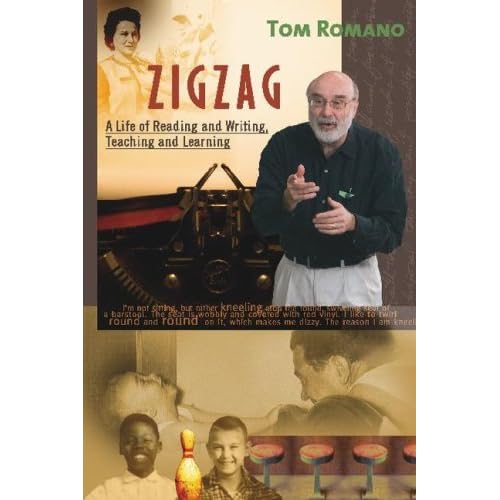
Zigzag: A Life of Reading and Writing, Teaching and Learning

In 1989, when I first attended the Sun Belt Writing Project’s summer institute, I was a lost puppy. After teaching for two years I was unsatisfied and knew I was not doing the kind of job I could be, should be, doing. As part of the institute I had to read several books, some of my own choosing. Clearing the Way, by Tom Romano was suggested to me as a good follow up to Nancie Atwell’s In the Middle. The director told me that since Romano was a high school teacher I might be able to get some good ideas from the book. And I did.

Now, almost 20 years later, I again am reading a new book by Tom Romano. This time it is a series of memoirs, short vignettes, that trace his development as a reader, a writer, a teacher, and (most importantly) as a person. Zigzag: A Life of Reading and Writing, Teaching and Learning should be required reading for anyone who wants to teach. Especially anyone who wants to teach English or language arts.


Divided into six sections, starting with his childhood and ending with his earning of a doctorate, he is honest and realistic. As most writers know that a piece of writing is a draft that can be revised and edited, Romano has shown by his own experiences that a life can also be revised and edited. He writes with humor and insight. It feels as though he is sitting across a table, telling stories from his past.

I found comfort that this acknowledged master teacher was no more interested in pursuing an education degree when he entered college than I was. He sort of fell into it, as did I. And it worked out for the best for him, even during periods of frustration. He ran into obstacles that all teachers face: uninspired students, outrageous workloads, unsympathetic administrators.

He at all points realistically points outs his weak spots as well as his strong spots. He sends a message that teaching is not some mystical profession that only a chosen few can accomplish. He gives hope to me as a teacher that I can continue on. He reminds me that ours is an important and sometimes misunderstood profession. He inspires me to carry on.

Wednesday, March 19, 2008

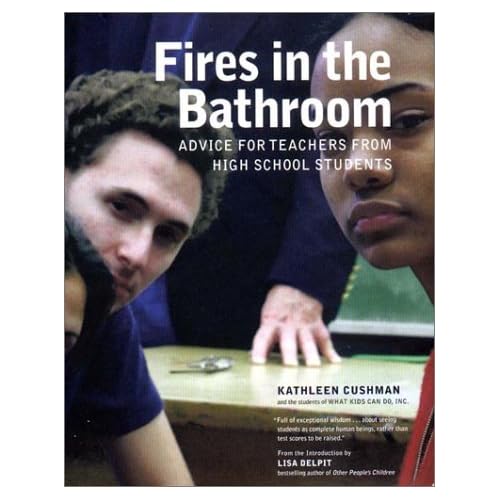
Book Review: Fires in the Bathroom

I recently read the book Fires in the Bathroom: Advice for Teachers from High School Students which was edited by Kathleen Cushman and written with the help of the students in What Kids Can Do, Inc. I have to admit I put this book down after almost 100 pages and took a break from it. I was having a rough time with the students I was teaching and my attitude sucked. As such, every comment I read from the students was greeted in my mind by anger and resentment. Unnecessarily so.


The students who participated in writing this book were paid for their time and, for the most part, took the work seriously. Some had legitimate complaints, such as teachers who were teaching out of field and did not know the subject, or strings of inadequate substitutes. Several said that after attempting to learn in that environment they considered it waste of time and stopped going to that particular class.

Other discussions in the book centered on the need for consistency in attitude and discipline procedures from the teachers. The need for respect to be a two way street. The problems I had here was that the students seem to expect the teachers to treat them with the utmost of respect at all times no matter what the students do. While that goal is lofty, sometimes, it just isn’t in the picture. At least for me. There are times when students have just plain lost my respect. And, of course, vice versa.

When I went back to the book with fresh eyes, and a more pleasant rapport with a new semester’s group of students, I found I was not annoyed by their comments, but rather saw those comments as rawly honest. These students want to have good teachers. And that does mean teachers who never give homework or test easily. It means teachers who can and will teach them the subject matter they need to know in an environment where they can learn it. Even if it means the occasion, respectful, kick in the butt.

Overall, I would recommend this book, especially for beginning teachers. It is a good insight into the adolescents you will be teaching. For those who have been in the classroom a while, read it when you aren’t stressed out by the students you’re teaching. It gave me a few new ways to think about my students and what they are going through at this stage of their lives.

Wednesday, November 28, 2007

NWP at NYC: Day Two

My second day in the City did start with something of a sense of urgency. The hotel somehow didn’t get me my wakeup call, so I overslept by about a half an hour or so. I had to walk about five blocks up to the Javits Center. Before nine. I had missed the Sun Belt first-morning-at-the-conference breakfast; the hotel it was at was in an inconvenient direction. They knew I wasn’t going to be there, so I felt a distinct lack of guilt about it.

About a block or so from the Javits Center I got my first cell phone call asking where I was. I told them and continued. In side the Javits Center it was another long walk to get to the opposite end. The first person I saw wasn’t a Sun Belter, but someone we all know and respect, Sherry Swain of the Mississippi Writing/Thinking Institute. She was talking with several Sun Belters. John, Cathy and Alyson were there, and also Whitney and Susan. Whit looked so happy to be in NYC and superexcited about being at the conference, her first. We made lunch plans then went to our morning sessions. I grabbed me a bagel on the way, so I wouldn’t starve.

I went to one on planning an online presence. As it was a three-hour long workshop, I was hoping for something good. And I was not disappointed. The facilitators started us off writing and discussing with people at our tables. The interaction with other Tech Liaisons (for most of the people there were) was, as always, refreshing. We are in tune and know the challenges the position entails. I am taking back to the group three very important questions. I want to discuss these with the leadership teams and with the site fellows in general. Here are the questions:

How would I describe the identity of Sun Belt?

What stands out most vividly for me about Sun Belt?

What people, places, activities most define Sun Belt?

If any Sun Belters read this, please comment on these. I am eager to know what y’all think.

I have my answers to them, but want to get other perspectives. Maybe I could start a wiki where we could discuss this...

I got to talking with the TL from Winthrop Writing Project out of South Carolina. Brandon was very energetic. He told me a bit about their new teacher initiative and it sounds like that site has it going on. I am hoping to keep in touch with him now that real life has returned.

I met the Sun Belters for lunch. The only place open in the whole of the Javits Center was one pizza fast food place. We were in a food court surrounded by closed fast food places. It was weird. And as the weather was stormy, leaving the Center wasn’t really an option. There were twenty or so people ahead of us on the line. We got on while the getting was good. By the time we finished our lunch and took off, the line stretched for hundreds of people. Poor planning for that part of the conference.

The afternoon session was another three-hour one. This one was ostensibly about planning inservice workshops (on writing and reading) for teachers in all subject areas. Disappointingly, the first presenter talked for over an hour. No interactivity. She had some good ideas, but the sheer length of the presentation wore. The second speaker had multicolored handouts for us to focus on and that was more palatable, but still, almost no interactivity. All in all, I was disappointed.

If you were only interested in the professional portion of the day, you can stop reading here. For the rest of the day, read on.

Then we left. As they searched for a cab, I decided to walk back to my hotel to put up the laptop. I couldn’t see carrying that with me. I hung out in my room a bit and then left to find my friends for drinks before dinner.

I got a call from John that they were at a place called The Social. It was very loud, but they made a halfway decent whiskey sour. We tried to talk for a bit, but it was hard to hear ourselves think, never mind talk. So after John attacked me with a lit candle, spilling white wax on my dark blue shirt, we took off to wander around until it was time for dinner.

We found a little shop that was a mom and pop art place. I looked a lot, but restrained myself. I did buy vicariously. I pointed out a couple of different cards to Whitney, who loved and bought them. I can’t remember the name of the place, but it was pretty cool.
Then dinner. Cathy got us reservations at 44 South West Italian Continental Restaurant. We were joined by Jordan and his boss from JSU. Also Will and Jessica Henry (Jess is a TC from our site) found us and a couple of teachers from Opelika High School who I never really got to meet or talk to, unfortunately. The food was great. The company was better. It was a great time. And the whiskey sour was a little stronger than that at The Social.

Then we broke up, sadly enough, and started to wander back toward the hotels the others were staying at. I wanted to walk around more, and Susie also wanted to walk around. So we broke off from the group and wandered down to Fifth Avenue again. I found out that Susie was also a sci-fi geek. That was cool. Then I got hit over the head by the tired stick and Susie was still busy taking pictures of publishing houses, so we went our separate ways.

I got back to my hotel and slept really well.

Friday, November 16, 2007

NYC for the NWP National Conference

When I got to NYC for the National Writing Project’s national conference, I got sort of a contact high from being in “the City.” I got to my hotel room, after a few minor hiccups caused my lack of attention to detail (Luckily I was not in any hurry and so I never felt like I was rushed. When there is no particular reason to hurry, why do so?). I got to my room and made the calls I needed to make to let people know I was here and safe. Then I had to get out and go walking. My hotel, The Americana Inn, is on 38th Street, just off of The Avenue of the Americas (6th Ave). That put me a few blocks from several NYC landmarks.

I walked toward Rockefeller Center, passing Bryant Park on the way. I had no idea where I was eventually going to wind up, and I didn’t care. I was walking around in NYC at night, and it felt totally safe. I don’t know why that surprises me. I felt safe in all the other big cities the NWP has visited in the past, but I was a little anxious before I got here.

I walked from 38th Street down to 47th and then farther. I passed by the Radio City Music Hall. I looked at the tree (not decorated, still scaffolded) at Rockefeller Center. Looking in, I saw that the ice skating rink there had been set up. Then I got to 5th Avenue and took a left. Soon I was passing by St. Patrick’s Cathedral. It is beautiful. I can’t imagine the amount of skill it took for the stone masons in the early 1800’s to build that.

I kept walking a while and pretty soon ended up at Central Park. Not feeling that I wanted to tempt fate, I didn’t actually enter the park. In fact within a couple of blocks I was turned around and headed back the way I came. By this time I was hungry and tried to spot some sort of a little diner to grab a nosh in. Two burger places I passed were already closed. But I did get to see the mass schedule at St. Patrick’s and decided to get there Sunday morning, if possible. I am not exactly sure when my plane is leaving. But with the first mass at 7:00, I ought to make it.

I passed by the NBC News building. Passed by Fox Noise, as well. Actually, the building doesn’t look evil from the outside. As I was headed back to my room, I saw a TGI Friday’s, and earlier I had passed a Mickey D’s, but I was damned if I was going to travel 1200 miles and somewhere I could at home. So I bought a hot dog, a pretzel, and a bottle of water from a street cart. I felt so New York.

Then it was back to the room, try to calm down and let the adrenaline rush level off. But when CSI: New York came on I was rejazzed. The main crime took place in Times Square, which is about a half mile or so from where I am staying.

I am not getting a wireless connection in the hotel, and I didn’t really expect one. I was annoyed that the phone won’t make outgoing calls without a $50 deposit. And then I’d be charged 85 cents a minute. No way! It took a couple of days, but I am now at a branch of the NY Public Library next to Bryant Park. And it was just a few blocks from my room.


I’ll write updates on my subsequent days soon. It has been packed.

Sunday, October 21, 2007

ACTE Conference 2007

Okay, before I forget too much about it, I would like to write a little about this year’s Alabama Council of Teachers of English conference. I was invited to submit a proposal for a workshop a long time ago and did so. This workshop is titled “Introducing Process Writing Using Legos.” I’ll get to that in a bit.

The day started off with a keynote speech by Carol Jago. She was lively and entertaining, as well as thought provoking. She posited that teachers are often not working in their students’ Zones of Proximal Development (ZPD) as proposed by Vygotsky. She thinks that a lot of teachers (and she did not exclude herself entirely) work in their students’ ZME: Zone of Minimal Effort.

She thinks that too often teachers make the work too easy for the students. She believes we should challenge our students more in the classroom. I have to say, she made some good points in her speech. She shared a lesson with us and got us talking to each other and sharing with each other. It was well done and thought provoking. A little while later I had a chance to meet her and talk to her a little one on one. She was friendly and interesting in person as well. She autographed a copy of her book Cohesive Writing for me. As soon as I finish Writing Brave and Free: Encouraging Words for People Who Want to Start Writing by Ted Kooser and Steve Cox I plan to read it.

The speaker at lunch was Watt Key, author of Alabama Moon. He was an entertaining speaker and kept the crowd of teachers laughing. He didn’t do a reading from his book, saying he always disliked going to readings of other authors (no matter how much he happened to like the author). Instead he told us stories about his time in college and his visit to New York after his book was accepted for publication.

My workshop came up after lunch. I started by defining an old definition of an expert--someone who travels more than 20 miles and provides handouts. It got the hoped for laugh and broke the ice. I then quickly explained the idea behind the activity, passing out bags of 25-30 Legos to groups of students who then build something with them. They also have to write specific instructions for another group to do the same. Then I take pics, the object gets deconstructed, and then another group (in a different class if possible) tries to recreate the original object following the directions.

It doesn’t take long to explain, even with a PowerPoint show of what my students created and what the next group created using the provided instructions. The meat of the workshop was actually breaking the teachers up into pairs (and one group of three due to the odd number) and letting them construct something, write instructions, deconstruct it and swap with another group. They all worked happily away while I wandered around the room and tried to keep out of their way.

I didn’t have my digital camera, as the battery is fried and will not hold a charge. I was a little at a loss until I though of my cell phone. I took pictures of the original objects with it and then emailed the pics to my myself. I was then able to open them up and show them to the group over the LCD projector hooked up to the classroom computer. It worked out pretty well. One of the participants told me that she appreciated the opportunity to actually do the activity. She said that if I had simply told them about it she would not have “gotten it.” But by letting them do it themselves she “got it.” I was pleased. I was also pleased that the extra handouts I had were mainly taken by the participants to share with other teachers at their schools.

I was going to try to go to another session after mine, but due t me heading for the wrong room, and staying there a while, I would have been unfashionably late. I was also a bit fatigued from the drive to Birmingham and the equally long search for a hotel room (apparently the Birmingham hotels were full with fans going to the Alabama/Tennessee football game the next day--serves m e right for not being a football fan). I decided to head for home.

Before I left, Cindy Adams, the president of the ACTE, and my friend, asked if I would like to be a Representative-at-Large for the ACTE, as there was no representation from my part of the state. I agreed. Now I will patiently wait for the other shoe to drop and find out what, exactly, I have signed on for. Whatever it is, I will do it the best I can. I am excited that Cindy is reviving the ACTE. It is a needed organization in the state.

I look forward to the next ACTE conference. I will try to have a new workshop set up for that one.

Thursday, July 12, 2007

Sun Belt Summer 2007

Since 1989 I have been a member of the Sun Belt Writing Project which is based at Auburn University in Alabama. I still remember my first summer institute. It was the summer after my second year of teaching and I was desperately looking for some way to become a better teacher. My first two years didn’t go well.

That summer I was introduced to the (then) new ideas of Nancie Atwell in her book In the Middle. I devoured Clearing the Way by Tom Romano, a book that showed me many practical applications of Atwell’s ideas. A book that is still relevant today. I was entranced by the simple advice of Natalie Goldberg to just write in Writing Down the Bones. This is another book that is a must read even still today.

I went back to my classroom and was determined to go with the workshop approach 100%. It was my tenure year, but I really didn’t care. That wasn’t bravery or zeal, I was young and figured if I lost that job I could always find another one. In fact, it might have been a motivator for me to move and go somewhere else.

We had new textbooks that year, replacing the books I had been furnished the first two (those books had been titled Modern English In Action—or was it--more aptly--Inaction?). I assigned the new books to my students. Had them write their names in them, in ink, as I was instructed to do. I then collected the books, put them in my closet and left them there the rest of the year. I had a 100% turn-in rate for books that year, not a single one was lost.

I was very lucky to work under a principal who trusted what I was doing and was strong enough in my district that I got tenure. He let me try the new method. All he wanted was for me to explain it to him so that he could explain it to the parents who called him with questions. Ah, the good old days.

I went back in 1991 as a senior fellow at my site. Basically, I wanted to hang around and they let me. I did it again in 1993 and 1995. I think I worked with the site again in 1997 or 1998, but I am a little hazy there. In 1999 I helped to keep the site alive when it hit a really low ebb. I have been there ever since. Somewhere along the way I started getting paid to do so. Now I am the Technical Liaison for my project. It means I like the techie stuff. Like blogs.

Some people, like my lovely wife, wonder why I do this every summer. Why do I make the drive to Auburn every day for four weeks (it was five until this year)? It is 40-45 minutes each way. And there is a time change involved, also. So I never really get to be on an even keel for the whole time I’m there.

I do it because it is a way for me to keep up with what is going on in the current research on writing and reading instruction. I do it because it is an opportunity to write. I do it because I have good friends there, the kind of friends that are more like family to me. And every summer I get to meet 10-15 incredible teachers. And this summer was no exception.

The amount of talent in the room was unbelievable. The conversations were zany at times and always interesting and informative. The teaching demonstrations were outstanding. The level of caring and commitment was off the charts. These people were the cream of the crop. And I am proud that I got to work with them and learn from them this summer.

But now it is over and the post-Sun Belt blues are kicking in. Tomorrow I will go and finish cleaning out the room. Then there is the report for the year. And then nothing.

As I live in a different city than almost all the participants of Sun Belt, I am now pretty much going to be cut off from all these wonderful people.

At least I am now in a school where I don’t have to be the lone stranger in the English department. In my old school no one ever wanted to go spend a summer at Sun Belt. Well, one person, but she went to a different school after her Sun Belt summer. Where I teach now there are several Sun Belt TC’s (Teacher Consultants). It makes the day a little less lonely.

But the TC’s from this summer are pretty much all Auburn folks. Except for one lady from Prattville and another from Guntersville. For those of you not familiar with Alabama geography, those places are a long way off from here. And I am back in Phenix City.

To any of the TC’s who may read this. Thanks for the great summer. I appreciate all the hard work you put in. And I really appreciate all the new ideas I get to take back to my classroom this year. Mostly I appreciate the warmth and good humor you all shared with me this summer. I hope that you all have your best year ever this year and every year after that, as well.