These are some web2.0 sites. Many are interactive and all can be used by teachers of any subject at any level (with one exception). I encourage you to check them out and see if you can make use of any of them in your class. I advise starting with one you really see a way to get creative with and getting good with that one. Then, as you begin to master that one, try another.
The Machine is Us/ing Us is a little video that shows how much writing and reading are changing. It also highlights the need for educators to keep up.
A Vision of Students Today is another video. College students let us know a little about how much they use technology.
Blabberize allows the user to upload a picture and then record something to make it talk.
Bubbl.Us is an online way to create clusters/idea webs.
Classtools.net has different useful tools. I like to use the countdown clock.
Common Craft has a number of three minute videos that cleverly explain a variety of web2.0 tools, as well as a few other needed explanations (anyone see zombies?).
Dabble Board is an online white board.
Definr is the fastest definition finder on the Internet. It says so right on the page.
Delicious is a social bookmarking site. You can save websites you like, tag them, and share them with others. It is an online tool, so you can use it from any computer hooked up to the Internet.
Free Rice is a game site, but with a difference. For every correct answer to the different online quizzes, ten grains of rice are donated to alleviate world hunger. It allows players to start at their own level and then gets easier or harder based on the answers the player gives.
Gallery of Writing was set up by the NCTE to showcase writing from around the country. They have open submissions and encourage participation.
Glogster is a kind of poster that is fully designed by the user. Users can incorporate text, images, music and video into their work.
Live Binders is a way to collect and present webpages on related subjects.
Make Belief Comix is another comics creator.
Prezi is a new online presentation tool that is a step beyond PowerPoints. It incorporates motion and zooming to make presentations more dynamic.
Slide Boom allows you to upload PowerPoint presentations to the web. After that, you can embed them in blogs, wikkis, websites, etc.
ToonDoo is a comics creation website. Users can make a short comic strip.
Virtual Literary Worlds is a series of links to online virtual worlds based on famous literature.
Voice Thread is a multimedia collaboration tool.
Wall Wisher is a virtual classroom bulletin board.
Wordle allows you generate text clouds.
Zamzar is a file converter. You send one type of medium to Zamzar, like a YouTube video, and convert it to another, like a Quicktime file. This is one way to get around blocks to YouTube and show your students those interesting videos you find.
Showing posts with label professional resources. Show all posts
Showing posts with label professional resources. Show all posts
Tuesday, June 15, 2010


Tuesday, February 16, 2010
Grammar Snobs Are Great Big Meanies--Review
Grammar Snobs Are Great Big Meanies by June Casagrande
This book is an anomaly: a grammar book this is fast-paced, fun to read, and chock full of information. The humorous tone of the book is at odds with the overly serious and somber tone of most grammar books. Casagrande goes out of her way to make her examples relevant and attention catching.
She tries to put her readers, those who have been abused by Grammar Snobs, at ease. She asserts the best reason to learn these rules is to put those Grammar Snobs in their place when they try to spring those picky little rules on you. And, to turn the tables on them by correcting them when they try to put you down with a rule that really isn’t grammatical.

For English teachers and for students who hate grammar, this is a book to take a look at. I am considering trying to get several copies to put into my classroom.
Thursday, July 9, 2009
Because Writing Matters--Review and Discussion Questions
To be honest, I got roped into reading this one. There was a kerfluffle having to do with two different workshops my writing project site was hosting this summer. One was an online book discussion group and one was based on the NWP publication Because Writing Matters. In the turn of events the book discussion group wound up reading this also.

I started the book with a great deal of reluctance. I expected it to be dry and dense. It was neither. The NWP and Carl Nagin did an excellent job of making the case for why there should be writing at all grade levels and in across the curriculum. He used case studies of real teachers and schools that used writing to improve their students academic achievement. Often these improvements were was about as subtle as news coverage of Michael Jackson’s funeral.
To help make the case to administrators and central office personnel, he focused some chapters on what they, by virtue of their jobs and the current political climate, must focus on: test scores. He also made sure that all the facts in the book were products of and backed up by research--not just the anecdotal evidence of a few classrooms. This is also mandatory today, as it should be. If teachers don’t use research to inform their instruction, they are doomed to Santayana’s vicious circle.
In reading the book I was reminded of practices that I need to promote more in my classroom and was constantly stopping the reading to either make notes about changes to my classroom site (or just going ahead and making the changes I wanted to see in my online world).
While the information here is nothing that an NWP member would not expect, it is still an excellent summation of the current research as well as a powerful argument for the need to make the teaching of writing all-pervasive in our schools, at all levels.
It would make excellent reading for staff development, especially via the format of professional reading groups. And, with that in mind, I would like to offer some of the pre-reading, reading, and post-reading questions that we developed in my book study group.
PREREADING QUESTIONS
1. Describe your view of the teacher's role in the teaching of writing.
2. Describe your view of the student's role in the teaching of writing.
3. Describe your view of the administrator’s role in the teaching of writing.
4. How would you rate the importance of writing in education in general, and your subject in particular?
(These would also make excellent post-reading questions. The participants could compare their original answers with those they hold after reading the book.)
QUESTIONS AFTER READING THE INTRODUCTION
1. Should there be a required course for all teachers on writing pedagogy?
2. How could it be "sold" to the students as being important in their particular discipline?
3. Should there be a stronger composition requirement for Language Arts majors? It seems that the stereotype of an English teacher has been someone who loves the literature so much they want to re-experience it and share it with others. Would a stronger writing component, maybe requiring courses in writing from the English department as well as literature, help?
4. What book on writing pedagogy has most influenced your instruction of writing in the classroom? I would be interested in more than the title and author, but also in the hows and whys of this book's importance to you. For the purposes of the question limit yourself to one (or at most two) books.
QUESTIONS AFTER READING CHAPTER ONE
1. If writing is a subject that can never truly be completely mastered, what should our goals as writing instructors be?
2. How do you deal with the ambiguity in writing instruction--the idea that there is no guaranteed formula for success every paper? How do you get students to deal with it without becoming so frustrated they quit writing?
3. How can we teach, maybe just can we teach, students to write “powerful, memorable, provocative, [and/] or moving” papers?
4. How would your faculty respond to a mandatory inservice (or series of inservices) on writing pedagogy? Can you think of any ways to promote more of a “buy in” by faculty members who are not specifically responsible for writing scores?
5. What are your assumptions about writing?
QUESTIONS AFTER READING CHAPTER TWO
1. Were you taught writing as a process or as a product? How did this influence your development as a writer?
2. How do you see the reading-writing connection as it relates to what you reach? How can you use this connection to improve your teaching?
3. Can technology improve the teaching of writing in your classroom? If so, how--if not, why not?
4. How can we help students who lack knowledge of “Standard English” to become better at that without making them so frustrated with writing that they rebel?
QUESTIONS AFTER READING CHAPTER THREE
1. Think of a writing assignment that you gave that maybe didn't go as well as you had hoped. Using the information in this chapter, what could you do to improve that lesson before you teach it again?
2. If you don’t have any lessons that include a writing component, pick a lesson that you could use writing with. How would you include writing in teaching that lesson?
QUESTIONS AFTER READING CHAPTER FOUR
1. How do we get our fellow teachers to buy into ongoing professional development on writing? What objections could you foresee to such a professional development plan? How can these objections be overcome?
2. How can school districts make it easier for teachers to do this kind of professional development? I know they could just order us to, but that produces attendance--not results. What can administrators and central office personnel do to help create acceptance of professional development for writing?
QUESTIONS AFTER READING CHAPTER FIVE
1. What is the impact of mandatory writing assessments in your classroom? In your school? In your district?
2. Beyond essay questions and research papers, how can you use writing in your classroom to assess student progress in your subject area?
3. How useful are rubrics? Should they be absolute or more flexible?
4. Should holistic assessments be more focused on content or correctness?
QUESTIONS AFTER READING CHAPTER SIX
1. What do you think about the concept of assigning writing vs teaching writing? Do you find the criteria valid? Using these criteria, which would you say you do in your classroom?
2. What lessons do you draw from the two case studies? Do you think they could (or should) be adapted for your school?
3. How can we get administrators and central office personnel to understand the importance of teaching writing across the curriculum at all grade levels?
POST READING QUESTIONS
These questions were posed on pages three and four of the book. They are good questions to keep in mind as you read and make excellent post reading discussion questions.
Why does writing matter?
What does research say about the teaching of writing?
What do we mean by “writing processes"?
What are some features of an effective writing classroom?
How can writing be used to develop critical thinking?
How does writing fit into learning across the disciplines?
What kind of professional development prepares teachers to teach and use writing?
What does a school wide writing program look like?
What are fair ways to assess writing?
I started the book with a great deal of reluctance. I expected it to be dry and dense. It was neither. The NWP and Carl Nagin did an excellent job of making the case for why there should be writing at all grade levels and in across the curriculum. He used case studies of real teachers and schools that used writing to improve their students academic achievement. Often these improvements were was about as subtle as news coverage of Michael Jackson’s funeral.
To help make the case to administrators and central office personnel, he focused some chapters on what they, by virtue of their jobs and the current political climate, must focus on: test scores. He also made sure that all the facts in the book were products of and backed up by research--not just the anecdotal evidence of a few classrooms. This is also mandatory today, as it should be. If teachers don’t use research to inform their instruction, they are doomed to Santayana’s vicious circle.
In reading the book I was reminded of practices that I need to promote more in my classroom and was constantly stopping the reading to either make notes about changes to my classroom site (or just going ahead and making the changes I wanted to see in my online world).
While the information here is nothing that an NWP member would not expect, it is still an excellent summation of the current research as well as a powerful argument for the need to make the teaching of writing all-pervasive in our schools, at all levels.
It would make excellent reading for staff development, especially via the format of professional reading groups. And, with that in mind, I would like to offer some of the pre-reading, reading, and post-reading questions that we developed in my book study group.
PREREADING QUESTIONS
1. Describe your view of the teacher's role in the teaching of writing.
2. Describe your view of the student's role in the teaching of writing.
3. Describe your view of the administrator’s role in the teaching of writing.
4. How would you rate the importance of writing in education in general, and your subject in particular?
(These would also make excellent post-reading questions. The participants could compare their original answers with those they hold after reading the book.)
QUESTIONS AFTER READING THE INTRODUCTION
1. Should there be a required course for all teachers on writing pedagogy?
2. How could it be "sold" to the students as being important in their particular discipline?
3. Should there be a stronger composition requirement for Language Arts majors? It seems that the stereotype of an English teacher has been someone who loves the literature so much they want to re-experience it and share it with others. Would a stronger writing component, maybe requiring courses in writing from the English department as well as literature, help?
4. What book on writing pedagogy has most influenced your instruction of writing in the classroom? I would be interested in more than the title and author, but also in the hows and whys of this book's importance to you. For the purposes of the question limit yourself to one (or at most two) books.
QUESTIONS AFTER READING CHAPTER ONE
1. If writing is a subject that can never truly be completely mastered, what should our goals as writing instructors be?
2. How do you deal with the ambiguity in writing instruction--the idea that there is no guaranteed formula for success every paper? How do you get students to deal with it without becoming so frustrated they quit writing?
3. How can we teach, maybe just can we teach, students to write “powerful, memorable, provocative, [and/] or moving” papers?
4. How would your faculty respond to a mandatory inservice (or series of inservices) on writing pedagogy? Can you think of any ways to promote more of a “buy in” by faculty members who are not specifically responsible for writing scores?
5. What are your assumptions about writing?
QUESTIONS AFTER READING CHAPTER TWO
1. Were you taught writing as a process or as a product? How did this influence your development as a writer?
2. How do you see the reading-writing connection as it relates to what you reach? How can you use this connection to improve your teaching?
3. Can technology improve the teaching of writing in your classroom? If so, how--if not, why not?
4. How can we help students who lack knowledge of “Standard English” to become better at that without making them so frustrated with writing that they rebel?
QUESTIONS AFTER READING CHAPTER THREE
1. Think of a writing assignment that you gave that maybe didn't go as well as you had hoped. Using the information in this chapter, what could you do to improve that lesson before you teach it again?
2. If you don’t have any lessons that include a writing component, pick a lesson that you could use writing with. How would you include writing in teaching that lesson?
QUESTIONS AFTER READING CHAPTER FOUR
1. How do we get our fellow teachers to buy into ongoing professional development on writing? What objections could you foresee to such a professional development plan? How can these objections be overcome?
2. How can school districts make it easier for teachers to do this kind of professional development? I know they could just order us to, but that produces attendance--not results. What can administrators and central office personnel do to help create acceptance of professional development for writing?
QUESTIONS AFTER READING CHAPTER FIVE
1. What is the impact of mandatory writing assessments in your classroom? In your school? In your district?
2. Beyond essay questions and research papers, how can you use writing in your classroom to assess student progress in your subject area?
3. How useful are rubrics? Should they be absolute or more flexible?
4. Should holistic assessments be more focused on content or correctness?
QUESTIONS AFTER READING CHAPTER SIX
1. What do you think about the concept of assigning writing vs teaching writing? Do you find the criteria valid? Using these criteria, which would you say you do in your classroom?
2. What lessons do you draw from the two case studies? Do you think they could (or should) be adapted for your school?
3. How can we get administrators and central office personnel to understand the importance of teaching writing across the curriculum at all grade levels?
POST READING QUESTIONS
These questions were posed on pages three and four of the book. They are good questions to keep in mind as you read and make excellent post reading discussion questions.
Why does writing matter?
What does research say about the teaching of writing?
What do we mean by “writing processes"?
What are some features of an effective writing classroom?
How can writing be used to develop critical thinking?
How does writing fit into learning across the disciplines?
What kind of professional development prepares teachers to teach and use writing?
What does a school wide writing program look like?
What are fair ways to assess writing?
Wednesday, August 27, 2008
Brain Rules

This summer I read several books on education. Why? Because I enjoy keeping current. At least that’s what I tell my wife when she asks me. And I do enjoy keeping current. I also just enjoy seeing classroom practice through someone else’s eyes. This professional reading for fun is a habit that started for me way back in 1989 when I attended my first summer invitational institute for the Sun Belt Writing Project. So much of what is good about my teaching comes from my almost 20 year association with Sun Belt.
This summer one of the books I read that just blew me away was Brain Rules: 12 Principles for Surviving and Thriving at Work, Home, and School by John Medina. At first it might seem an unlikely pick for an English teacher. After all, what do I know about neuroscience? What does the way the brain works have to do with me?
As a teacher, the way the brain works should have a lot to do with the way I teach. After all, as I learn better how the brain works, I can make adjustments to my teaching in order to take full advantage of the knowledge. Here are the 12 rules:
Rule #1: Exercise boosts brain power.
Rule #2: The human brain evolved, too.
Rule #3: Every brain is wired differently.
Rule #4: We don't pay attention to boring things.
Rule #5: Repeat to remember.
Rule #6: Remember to repeat.
Rule #7: Sleep well, think well.
Rule #8: Stressed brains don't learn the same way.
Rule #9: Stimulate more of the senses.
Rule #10: Vision trumps all other senses.
Rule #11: Male and female brains are different.
Rule #12: We are powerful and natural explorers.
While some of the above rules may seem to be intuitive, each is treated with scientific rigor. He has had the time and the expertise to research these matters and come up with some evidence of their effectiveness. I usually fuzz out on specifics and can only remember that I heard it somewhere. Not the most convincing of arguments. At the same time, Medina does not claim to have all the answers and throughout the book sets up intriguing questions for further research.
Medina has turned Brain Rules into a multimedia experience. He has a website with short videos on the major concepts of the rules and a blog. I have subscribed to the blog and look at the videos and other extra info on the website frequently. I especially like the tutorials on each of the rules. They are entertaining as well as informative.
Whether or not I will make use of all the incredible information in the book is, of course, the question. In order to try I am trying to get a Professional Reading Group going this year. I have already received a preliminary okay on it from the school level. Now we are just waiting to hear from the central office level. The hitch to cover is that I am trying to get this group professional development credit for reading the book and discussing it.
Here’s hoping that the book will do me and, more importantly, my students, some good.
Wednesday, July 23, 2008
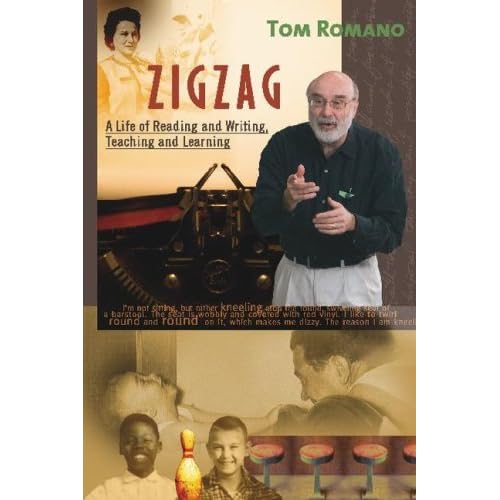
Zigzag: A Life of Reading and Writing, Teaching and Learning
In 1989, when I first attended the Sun Belt Writing Project’s summer institute, I was a lost puppy. After teaching for two years I was unsatisfied and knew I was not doing the kind of job I could be, should be, doing. As part of the institute I had to read several books, some of my own choosing. Clearing the Way, by Tom Romano was suggested to me as a good follow up to Nancie Atwell’s In the Middle. The director told me that since Romano was a high school teacher I might be able to get some good ideas from the book. And I did.
Now, almost 20 years later, I again am reading a new book by Tom Romano. This time it is a series of memoirs, short vignettes, that trace his development as a reader, a writer, a teacher, and (most importantly) as a person. Zigzag: A Life of Reading and Writing, Teaching and Learning should be required reading for anyone who wants to teach. Especially anyone who wants to teach English or language arts.

Divided into six sections, starting with his childhood and ending with his earning of a doctorate, he is honest and realistic. As most writers know that a piece of writing is a draft that can be revised and edited, Romano has shown by his own experiences that a life can also be revised and edited. He writes with humor and insight. It feels as though he is sitting across a table, telling stories from his past.
I found comfort that this acknowledged master teacher was no more interested in pursuing an education degree when he entered college than I was. He sort of fell into it, as did I. And it worked out for the best for him, even during periods of frustration. He ran into obstacles that all teachers face: uninspired students, outrageous workloads, unsympathetic administrators.
He at all points realistically points outs his weak spots as well as his strong spots. He sends a message that teaching is not some mystical profession that only a chosen few can accomplish. He gives hope to me as a teacher that I can continue on. He reminds me that ours is an important and sometimes misunderstood profession. He inspires me to carry on.
Now, almost 20 years later, I again am reading a new book by Tom Romano. This time it is a series of memoirs, short vignettes, that trace his development as a reader, a writer, a teacher, and (most importantly) as a person. Zigzag: A Life of Reading and Writing, Teaching and Learning should be required reading for anyone who wants to teach. Especially anyone who wants to teach English or language arts.
Divided into six sections, starting with his childhood and ending with his earning of a doctorate, he is honest and realistic. As most writers know that a piece of writing is a draft that can be revised and edited, Romano has shown by his own experiences that a life can also be revised and edited. He writes with humor and insight. It feels as though he is sitting across a table, telling stories from his past.
I found comfort that this acknowledged master teacher was no more interested in pursuing an education degree when he entered college than I was. He sort of fell into it, as did I. And it worked out for the best for him, even during periods of frustration. He ran into obstacles that all teachers face: uninspired students, outrageous workloads, unsympathetic administrators.
He at all points realistically points outs his weak spots as well as his strong spots. He sends a message that teaching is not some mystical profession that only a chosen few can accomplish. He gives hope to me as a teacher that I can continue on. He reminds me that ours is an important and sometimes misunderstood profession. He inspires me to carry on.
Tuesday, April 29, 2008
Disappointed
Last week my ninth graders started getting ready to read To Kill a Mockingbird. They may not have been completely aware of it as my way of getting them ready was to do a webquest on the history of Jim Crow. I adapted this last year when I was teaching TKAM for the first time. Odd, it was my twentieth year of teaching, but my first time teaching that novel. I guess it isn’t really big in the seventh and eighth grades around here. Today I passed out index cards for them to write five things they learned about Jim Crow from the webquest. If the chatter I heard during class is any indication, this assignment didn’t go well.
They had a paper to write on what they had learned and I tried to take it up today. It was due yesterday, but I was absent and could not collect it. Discounting the absent students and those at the ALC, I had about 23 students Friday who received the assignment. I had seven turn in the paper. Two more claimed it was done, but not here due to computer problems. We shall see.
This is, unfortunately, not an isolated incident in the classes I teach. Assignments, whether to be done in class or at home, are viewed by many of my students as optional. Over half the ninth graders did not do a parts of speech project that was required of them (I was told by my department head I had to review the parts of speech with my students). Most took a 150 point zero. Why? It wasn’t that difficult, just involved enough that it would take them some time to do it well. And most opted not to. The grades they earned for it were not, on the whole, very good. They had a chance to revise it and turn it in for a higher grade. One student took me up on that.
It is not just this class. It is not just ninth graders. It is not just my school. My wife has similar problems in a tenth grade physical science class in a high school in Georgia. And her class is required for graduation! As is my ninth grade English class.
I guess the best I can do is not take it personally. It seems that this is not aimed specifically at me, but it is more of a growing problem. I am not a big homework giver, but when I do give it, I expect it to be done. Maybe I am just too unreasonable. I expect them to care about their educations. Maybe I should check up on my Maslow’s Hierarchy again.
They had a paper to write on what they had learned and I tried to take it up today. It was due yesterday, but I was absent and could not collect it. Discounting the absent students and those at the ALC, I had about 23 students Friday who received the assignment. I had seven turn in the paper. Two more claimed it was done, but not here due to computer problems. We shall see.
This is, unfortunately, not an isolated incident in the classes I teach. Assignments, whether to be done in class or at home, are viewed by many of my students as optional. Over half the ninth graders did not do a parts of speech project that was required of them (I was told by my department head I had to review the parts of speech with my students). Most took a 150 point zero. Why? It wasn’t that difficult, just involved enough that it would take them some time to do it well. And most opted not to. The grades they earned for it were not, on the whole, very good. They had a chance to revise it and turn it in for a higher grade. One student took me up on that.
It is not just this class. It is not just ninth graders. It is not just my school. My wife has similar problems in a tenth grade physical science class in a high school in Georgia. And her class is required for graduation! As is my ninth grade English class.
I guess the best I can do is not take it personally. It seems that this is not aimed specifically at me, but it is more of a growing problem. I am not a big homework giver, but when I do give it, I expect it to be done. Maybe I am just too unreasonable. I expect them to care about their educations. Maybe I should check up on my Maslow’s Hierarchy again.
Monday, April 14, 2008
Found Poem Variation
On Friday I worked with a variation of found poetry that I developed for my classes several years ago. I have published my 2004 Sun Belt presentation on Google Docs, just in case anyone would like to take a look at it.
Thursday, April 10, 2008
Poetry PPT and Website
As part of National Poetry Month, I am focusing more on poetry in my classes. I took a look at the Tabloid Headline Poems that they turned in last week and noticed that a sizable portion of my students had no clue about line breaks--what they were or how to use them. So, I took an old handout I used to use with my students and turned it into a PowerPoint presentation that we worked through.
I also found a pretty cool website on the subject of interpreting poems.
SOYOUWANNA INTERPRET A POEM?
I also found a pretty cool website on the subject of interpreting poems.
SOYOUWANNA INTERPRET A POEM?
Tuesday, April 8, 2008
Two Views on Why Public Schools Suck
Apparently my blog is a feast or famine thing. Currently we are in feast mode (a terrific way to avoid grading papers I desperately do not want to grade, while still feeling productive).
I have a bunch of subscriptions to science blogs. Why? I just do. Seems like I can always find something interesting in one of them. Well, as I was going through some back entries today a couple caught my eye and I thought I'd share them. Feel free to chime in with your comments. I know our schools have some troubles--exaggerated in some cases, underreported in others--but it just always pisses me off to hear the entire US school system constantly trashed.
Here's the first one--feminists beware! Women's Liberation Movement and Public Schools.
And here's one on our national disorganization: Nationalize Public Schools. Sorry. I am not currently in the mood to nationalize very much. At least not until we are under new management. And probably not then, either. Who knows what the next management shift might bring.
I have a bunch of subscriptions to science blogs. Why? I just do. Seems like I can always find something interesting in one of them. Well, as I was going through some back entries today a couple caught my eye and I thought I'd share them. Feel free to chime in with your comments. I know our schools have some troubles--exaggerated in some cases, underreported in others--but it just always pisses me off to hear the entire US school system constantly trashed.
Here's the first one--feminists beware! Women's Liberation Movement and Public Schools.
And here's one on our national disorganization: Nationalize Public Schools. Sorry. I am not currently in the mood to nationalize very much. At least not until we are under new management. And probably not then, either. Who knows what the next management shift might bring.
A Little Something for NaPoMo
If you click on the menu button, you can find the code to embed this in your own blog or website. I would be flattered if you want to use it. If you do, please let me know. I'm interested in how useful this could be.
Wednesday, March 19, 2008
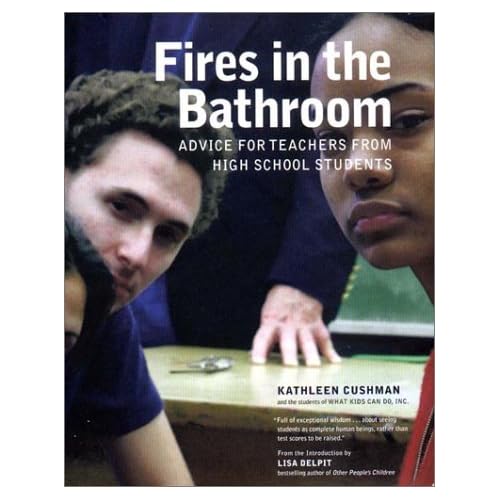
Book Review: Fires in the Bathroom
I recently read the book Fires in the Bathroom: Advice for Teachers from High School Students which was edited by Kathleen Cushman and written with the help of the students in What Kids Can Do, Inc. I have to admit I put this book down after almost 100 pages and took a break from it. I was having a rough time with the students I was teaching and my attitude sucked. As such, every comment I read from the students was greeted in my mind by anger and resentment. Unnecessarily so.

The students who participated in writing this book were paid for their time and, for the most part, took the work seriously. Some had legitimate complaints, such as teachers who were teaching out of field and did not know the subject, or strings of inadequate substitutes. Several said that after attempting to learn in that environment they considered it waste of time and stopped going to that particular class.
Other discussions in the book centered on the need for consistency in attitude and discipline procedures from the teachers. The need for respect to be a two way street. The problems I had here was that the students seem to expect the teachers to treat them with the utmost of respect at all times no matter what the students do. While that goal is lofty, sometimes, it just isn’t in the picture. At least for me. There are times when students have just plain lost my respect. And, of course, vice versa.
When I went back to the book with fresh eyes, and a more pleasant rapport with a new semester’s group of students, I found I was not annoyed by their comments, but rather saw those comments as rawly honest. These students want to have good teachers. And that does mean teachers who never give homework or test easily. It means teachers who can and will teach them the subject matter they need to know in an environment where they can learn it. Even if it means the occasion, respectful, kick in the butt.
Overall, I would recommend this book, especially for beginning teachers. It is a good insight into the adolescents you will be teaching. For those who have been in the classroom a while, read it when you aren’t stressed out by the students you’re teaching. It gave me a few new ways to think about my students and what they are going through at this stage of their lives.
The students who participated in writing this book were paid for their time and, for the most part, took the work seriously. Some had legitimate complaints, such as teachers who were teaching out of field and did not know the subject, or strings of inadequate substitutes. Several said that after attempting to learn in that environment they considered it waste of time and stopped going to that particular class.
Other discussions in the book centered on the need for consistency in attitude and discipline procedures from the teachers. The need for respect to be a two way street. The problems I had here was that the students seem to expect the teachers to treat them with the utmost of respect at all times no matter what the students do. While that goal is lofty, sometimes, it just isn’t in the picture. At least for me. There are times when students have just plain lost my respect. And, of course, vice versa.
When I went back to the book with fresh eyes, and a more pleasant rapport with a new semester’s group of students, I found I was not annoyed by their comments, but rather saw those comments as rawly honest. These students want to have good teachers. And that does mean teachers who never give homework or test easily. It means teachers who can and will teach them the subject matter they need to know in an environment where they can learn it. Even if it means the occasion, respectful, kick in the butt.
Overall, I would recommend this book, especially for beginning teachers. It is a good insight into the adolescents you will be teaching. For those who have been in the classroom a while, read it when you aren’t stressed out by the students you’re teaching. It gave me a few new ways to think about my students and what they are going through at this stage of their lives.
Tuesday, March 18, 2008
Web English Teacher Rules!
I have been having some fun in my English classes lately teaching some short stories. But I wanted some more resources, so I started looking and found a lot of helpful information at webenglishteacher.com. I highly recommend this site; it is an excellent resource for language arts teachers of all levels. While I am at the recommending, let me also recommend the blog that the Web English Teacher keeps. I got to poking around in it yesterday and in the blink of an eye two hours of my life disappeared. It is well written and has many fascinating links. But do be warned that it is a time sink. A pleasurable one, but a time sink none the same. I blame W.E.T. for being such an extremely entertaining blogger.
Subscribe to:
Posts (Atom)

 Posts
Posts


