Showing posts with label recommendations. Show all posts

Friday, September 7, 2018

Recommending Mr. Fitz


The other day I mentioned here that there were times when I taught when I was certain no one else knew what I was going through. Well, there is someone else who really seems to get it: David Finkle. He is the creator of the Mr. Fitz comic strip.

Finkle is a former middle school/current high school English teacher. He knows what he’s drawing and writing about in this strip. I would like to suggest you give his website, http://mrfitz.com.

He covers the gamut of what it is like to teach in an age of growing demonization of teachers and teaching. And he does it in a really funny way. In addition to being a loyal reader, I’ve bought two of his Mr. Fitz books, which collect the strips from the web. 

Here are a couple of his strips he said I could use for this post. 


So look for Mr. Fitz on Facebook and on the Web. 

Tuesday, June 15, 2010

Web2.0 Resources

These are some web2.0 sites. Many are interactive and all can be used by teachers of any subject at any level (with one exception). I encourage you to check them out and see if you can make use of any of them in your class. I advise starting with one you really see a way to get creative with and getting good with that one. Then, as you begin to master that one, try another.


The Machine is Us/ing Us is a little video that shows how much writing and reading are changing. It also highlights the need for educators to keep up.

A Vision of Students Today is another video. College students let us know a little about how much they use technology.

Blabberize allows the user to upload a picture and then record something to make it talk.

Bubbl.Us is an online way to create clusters/idea webs.

Classtools.net has different useful tools. I like to use the countdown clock.

Common Craft has a number of three minute videos that cleverly explain a variety of web2.0 tools, as well as a few other needed explanations (anyone see zombies?).

Dabble Board is an online white board.

Definr is the fastest definition finder on the Internet. It says so right on the page.

Delicious is a social bookmarking site. You can save websites you like, tag them, and share them with others. It is an online tool, so you can use it from any computer hooked up to the Internet.

Free Rice is a game site, but with a difference. For every correct answer to the different online quizzes, ten grains of rice are donated to alleviate world hunger. It allows players to start at their own level and then gets easier or harder based on the answers the player gives.

Gallery of Writing was set up by the NCTE to showcase writing from around the country. They have open submissions and encourage participation.

Glogster is a kind of poster that is fully designed by the user. Users can incorporate text, images, music and video into their work.

Live Binders is a way to collect and present webpages on related subjects.

Make Belief Comix is another comics creator.

Prezi is a new online presentation tool that is a step beyond PowerPoints. It incorporates motion and zooming to make presentations more dynamic.

Slide Boom allows you to upload PowerPoint presentations to the web. After that, you can embed them in blogs, wikkis, websites, etc.

ToonDoo is a comics creation website. Users can make a short comic strip.

Virtual Literary Worlds is a series of links to online virtual worlds based on famous literature.

Voice Thread is a multimedia collaboration tool.

Wall Wisher is a virtual classroom bulletin board.

Wordle allows you generate text clouds.

Zamzar is a file converter. You send one type of medium to Zamzar, like a YouTube video, and convert it to another, like a Quicktime file. This is one way to get around blocks to YouTube and show your students those interesting videos you find.

Monday, July 6, 2009

Writer's Book of Wisdom--Review

Every summer I go on a reading orgy. I read lots of books that are what I call brain candy. They are quick, fun, and not in any way taxing on my brain. I tend to read of lot of  urban fantasy--fantasy novels set in the contemporary world.  

But, eventually, I start to think that, for some reason, I really ought to read some professional books. I love to read books about writing. I can read books on pedagogy and theory, but I am frankly not as patient with them. I like to get to the nuts and the bolts. So, after reading ten or twelve fantasies (and some graphic novels, too--almost forgot those), I pulled out a book I purchased in May with a birthday book card I received and began to read it.

And a few days ago I finished reading The Writer’s Book of Wisdom: 101 Rules for Mastering Your Craft by Steven Taylor Goldsberry. It is set up as a list of rules. The author himself acknowledges at the end that some of the “rules” contradict each other. That is okay. Different people need different guidance. There is something in here for just about everyone. With each rule lasting only a page or two long, the book reads quickly. That is, if all you do is read it.


It is intended to be more than a quick read. It is intended to be inspirational--get the reader energized to trade reading for writing. As I usually find in these books it tends to slant heavily to narrative fiction. That is somewhat useful to me professionally, as I need to teach narrative writing. It is not as useful to me as a writer. I tend to write poetry and nonfiction. There were some ideas that I found useful for those genres as well.

Some of the rules are gems that I am going to use with my writing classes next year. They will be easy to build mini-lessons around. For instance, in discussion of dialogue, Goldsberry breaks that topic into three of his rules. It reminded me that, as a teacher I need to break down the processes more for my students. It also, by its very structure, exhibits and promotes the idea of strategic writing. Have a plan going in. Know what you want to accomplish. Think of your audience to help figure out the best way to accomplish the goal you set yourself.

I am working on getting a list of nonfiction writing titles together for inclusion in a classroom library. While I would not put this book in the same league as Writing Down the Bones or Writing Toward Home, it is in some ways more accessible to beginning writers, I think. It is informative, interesting, casual in tone, and well worth the time.

©2009-Art Belliveau

Friday, September 12, 2008

The Man Who Planted Trees

Note: I wrote this during and after school yesterday, but didn't get the chance to post it.

Today’s journal entry is a question: Can one person change the world? Explain your answer.

I am interested to see what my students think. Do they believe it is possible for one person to affect world change? I know already that I believe it is. And that the fact has been demonstrably proven with both positive and negatives effects.

Take Khalid Sheikh Mohammed as an example of changing the world in a negative way. He was the mastermind behind the 9/11 terrorist attack on the US. That one man did change the world. Wars started. Prejudice and hatred increased. Terrorist attacks have risen. Tens of millions of the world’s poorest children starved to death as direct and indirect result of the economic upheavals that occurred.

On a more positive note, as one of my students pointed out, Gandhi was a person who affected a positive change upon the world. I elaborated by pointing out that the non-violent resistance was not only successful in India, but also in South Africa and the United States as well. Gandhi began his nonviolent resistance in South Africa and that legacy lasted. There was a change of government there that did not require civil war and millions upon millions dead. And Martin Luther King, Jr. adapted the lessons of Gandhi to the civil rights protests right here. Imagine the different way our society and the world would have reacted if the marchers in Birmingham had shot back at the police--or if the Freedom Riders came in armed and shooting.

Some students who are adamant that no one person can change the world, that doing that is up to God. Or that it was just plain impossible. It is a more than a little sad that their life experiences to date have trained them to nihilism. Some are very fatalistic. Some are full of anger. Some have already given up and are trying to live life without the benefit of hope.

Then I showed them the movie The Man Who Planted Trees, from the story by Jean Giono. It is an inspirational story of a man who plants trees, just because he felt the need to do so. And over the course of years he planted a forest. And very slowly and quietly, never seeking recognition, the forest grew. Most others thought that this was a miracle of nature.

To see the changes that this one man nurtured, through two world wars, is little short of miraculous. The animation of the film is breathtaking. It is simple yet profound, as befits the story it tells. I always find it to be an uplifting experience to watch this film.

Giono later wrote, after being asked many times, that the story was a work of fiction. But that should not deter us from believing the deeper message: one man can change the world. I point out the many thousands of people inspired by this story to plant trees. Millions of trees around the world have been planted by those who read the story. Or by others who were inspired by these people. One man, in this case Giono, has made a difference.

I love the power of writing.

Wednesday, September 3, 2008

Fun How To Video

In an unusual move, I am posting a second time today. If you have not seen any of the videos for the Common Craft Show you are missing a treat. They put together short videos that clearly explain some difficult concepts. What is prompting me to post about it is that on their blog today they have posted a "behind the scenes look" at how one of their videos is made.

I was thinking that as I go into working with the process analysis paper for expostiory writing, this would be a good example to use. I would start by showing the video then directing them to the blog entry, then watching the video again. They would have an excellent example of how to explain something step by step.

And maybe I could get them to watch another of the videos and analyze how it goes step by step in process analysis.

What's your view on this?

Wednesday, August 27, 2008

Brain Rules


This summer I read several books on education. Why? Because I enjoy keeping current. At least that’s what I tell my wife when she asks me. And I do enjoy keeping current. I also just enjoy seeing classroom practice through someone else’s eyes. This professional reading for fun is a habit that started for me way back in 1989 when I attended my first summer invitational institute for the Sun Belt Writing Project. So much of what is good about my teaching comes from my almost 20 year association with Sun Belt.

This summer one of the books I read that just blew me away was Brain Rules: 12 Principles for Surviving and Thriving at Work, Home, and School by John Medina. At first it might seem an unlikely pick for an English teacher. After all, what do I know about neuroscience? What does the way the brain works have to do with me?

As a teacher, the way the brain works should have a lot to do with the way I teach. After all, as I learn better how the brain works, I can make adjustments to my teaching in order to take full advantage of the knowledge. Here are the 12 rules:

Rule #1: Exercise boosts brain power.
Rule #2: The human brain evolved, too.
Rule #3: Every brain is wired differently.
Rule #4: We don't pay attention to boring things.
Rule #5: Repeat to remember.
Rule #6: Remember to repeat.
Rule #7: Sleep well, think well.
Rule #8: Stressed brains don't learn the same way.
Rule #9: Stimulate more of the senses.
Rule #10: Vision trumps all other senses.
Rule #11: Male and female brains are different.
Rule #12: We are powerful and natural explorers.

While some of the above rules may seem to be intuitive, each is treated with scientific rigor. He has had the time and the expertise to research these matters and come up with some evidence of their effectiveness. I usually fuzz out on specifics and can only remember that I heard it somewhere. Not the most convincing of arguments. At the same time, Medina does not claim to have all the answers and throughout the book sets up intriguing questions for further research.

Medina has turned Brain Rules into a multimedia experience. He has a website with short videos on the major concepts of the rules and a blog. I have subscribed to the blog and look at the videos and other extra info on the website frequently. I especially like the tutorials on each of the rules. They are entertaining as well as informative.

Whether or not I will make use of all the incredible information in the book is, of course, the question. In order to try I am trying to get a Professional Reading Group going this year. I have already received a preliminary okay on it from the school level. Now we are just waiting to hear from the central office level. The hitch to cover is that I am trying to get this group professional development credit for reading the book and discussing it.

Here’s hoping that the book will do me and, more importantly, my students, some good.

Wednesday, July 23, 2008

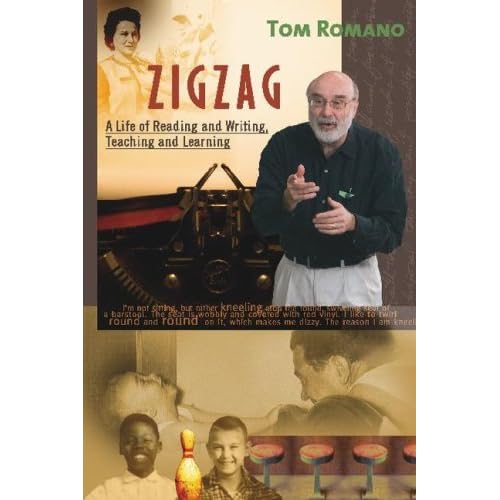
Zigzag: A Life of Reading and Writing, Teaching and Learning

In 1989, when I first attended the Sun Belt Writing Project’s summer institute, I was a lost puppy. After teaching for two years I was unsatisfied and knew I was not doing the kind of job I could be, should be, doing. As part of the institute I had to read several books, some of my own choosing. Clearing the Way, by Tom Romano was suggested to me as a good follow up to Nancie Atwell’s In the Middle. The director told me that since Romano was a high school teacher I might be able to get some good ideas from the book. And I did.

Now, almost 20 years later, I again am reading a new book by Tom Romano. This time it is a series of memoirs, short vignettes, that trace his development as a reader, a writer, a teacher, and (most importantly) as a person. Zigzag: A Life of Reading and Writing, Teaching and Learning should be required reading for anyone who wants to teach. Especially anyone who wants to teach English or language arts.


Divided into six sections, starting with his childhood and ending with his earning of a doctorate, he is honest and realistic. As most writers know that a piece of writing is a draft that can be revised and edited, Romano has shown by his own experiences that a life can also be revised and edited. He writes with humor and insight. It feels as though he is sitting across a table, telling stories from his past.

I found comfort that this acknowledged master teacher was no more interested in pursuing an education degree when he entered college than I was. He sort of fell into it, as did I. And it worked out for the best for him, even during periods of frustration. He ran into obstacles that all teachers face: uninspired students, outrageous workloads, unsympathetic administrators.

He at all points realistically points outs his weak spots as well as his strong spots. He sends a message that teaching is not some mystical profession that only a chosen few can accomplish. He gives hope to me as a teacher that I can continue on. He reminds me that ours is an important and sometimes misunderstood profession. He inspires me to carry on.

Sunday, April 20, 2008

The Inner City Mother Goose

I have never thought of poet Eve Merriam as a controversial writer. The poetry I had read of hers was childlike in its wonder and had an innocent playfulness about it. Imagine then, my surprise when I checked out a copy of Inner City Mother Goose from my local library.

The introduction by Nikki Giovanni let me know that this wasn’t going to be the cute, sweet poems by Merriam, but rather a form of social commentary on some rather obvious societal inequities.


In her own introduction to the 1982 edition (it was originally published in the late 60’s) Merriam recounts the book’s being banned in several places, including colleges. She hints at a thirteen letter word she used in one of her modern nursery rhyme retellings. Apparently that one caused a great deal of trouble.

As with most social satire this is not always a comfortable book to read. There are some poems that made me squirm a bit. But it also fits in with a new awakening in me for more social justice.

The illustrations by David Diaz fit the poetry extremely well. They had a reality that spoke through them, as did the poems.

While I might not recommend it for the classroom, necessarily, I would recommend this book to be read by those who teach in inner city schools and/or by those who are interested in social justice issues.

Monday, April 7, 2008

Elie Wiesel on NPR

For those of you who teach Night (or those of you who are just a fan of the author), I heard something really interesting today. I was listening to All Things Considered on NPR and heard Elie Wiesel read his essay for "This I Believe." It is already on ATC's website. It will also be podcast soon and is on the site for "This I Believe." It is worth a listen to. He brings to life Santayana's quote: "Those who cannot remember the past are condemned to repeat it."

Wednesday, March 19, 2008

Creativity


I recommend that you grab a copy of the December 2007 issue of Writer's Digest. It was an issue that spotlighted creativity. Several of the articles are available online: "Meeting of the Minds," "Overcoming Too Many Ideas Syndrome," and "Falling Down the Rabbit Hole." There was also an interesting and informative article on mind mapping, complete with references to Gabriele Rico and Writing the Natural Way, which I first read in 1987 during my first Sun Belt Writing Project Invitational Summer Institute. Unfortunately that one isn't online.

I think that as a writing teacher this magazine is an extremely important resource. It helps me to remember to focus on the writing and to remember that it is not as easy as it sometimes seems to be. It takes a lot of work and dedication to create a worthwhile piece of writing. And that is why I am in the job I am: helping the students realize that good writing isn't a matter of luck, but a matter of craft.

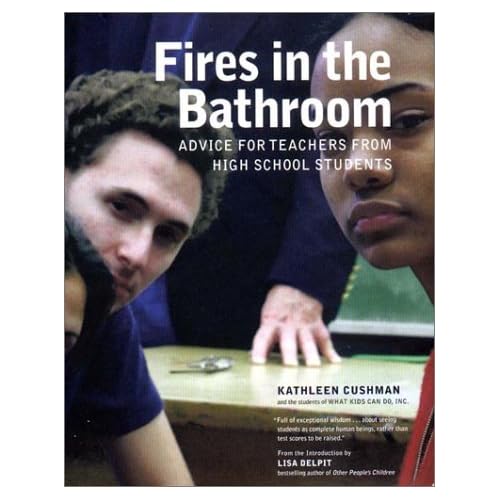
Book Review: Fires in the Bathroom

I recently read the book Fires in the Bathroom: Advice for Teachers from High School Students which was edited by Kathleen Cushman and written with the help of the students in What Kids Can Do, Inc. I have to admit I put this book down after almost 100 pages and took a break from it. I was having a rough time with the students I was teaching and my attitude sucked. As such, every comment I read from the students was greeted in my mind by anger and resentment. Unnecessarily so.


The students who participated in writing this book were paid for their time and, for the most part, took the work seriously. Some had legitimate complaints, such as teachers who were teaching out of field and did not know the subject, or strings of inadequate substitutes. Several said that after attempting to learn in that environment they considered it waste of time and stopped going to that particular class.

Other discussions in the book centered on the need for consistency in attitude and discipline procedures from the teachers. The need for respect to be a two way street. The problems I had here was that the students seem to expect the teachers to treat them with the utmost of respect at all times no matter what the students do. While that goal is lofty, sometimes, it just isn’t in the picture. At least for me. There are times when students have just plain lost my respect. And, of course, vice versa.

When I went back to the book with fresh eyes, and a more pleasant rapport with a new semester’s group of students, I found I was not annoyed by their comments, but rather saw those comments as rawly honest. These students want to have good teachers. And that does mean teachers who never give homework or test easily. It means teachers who can and will teach them the subject matter they need to know in an environment where they can learn it. Even if it means the occasion, respectful, kick in the butt.

Overall, I would recommend this book, especially for beginning teachers. It is a good insight into the adolescents you will be teaching. For those who have been in the classroom a while, read it when you aren’t stressed out by the students you’re teaching. It gave me a few new ways to think about my students and what they are going through at this stage of their lives.

Tuesday, March 18, 2008

Web English Teacher Rules!

I have been having some fun in my English classes lately teaching some short stories. But I wanted some more resources, so I started looking and found a lot of helpful information at webenglishteacher.com. I highly recommend this site; it is an excellent resource for language arts teachers of all levels. While I am at the recommending, let me also recommend the blog that the Web English Teacher keeps. I got to poking around in it yesterday and in the blink of an eye two hours of my life disappeared. It is well written and has many fascinating links. But do be warned that it is a time sink. A pleasurable one, but a time sink none the same. I blame W.E.T. for being such an extremely entertaining blogger.